 Agentic Capital · Trustless Joint Ownership
Don't trust the agent. Trust the market.
The obvious way for ten thousand owners to steer a fund is to vote, and why it fails is simple: under a vote, a majority can do anything, including pay itself. Kevin Heavey put the diagnosis in one line: joint ownership without minority protection is an illusion. Companies solve the problem with courts, which is why a small shareholder can own a public company today without being robbed by its largest. Courts are slow, expensive and unavailable to strangers on a ledger. A decision market solves the problem with conditional prices.
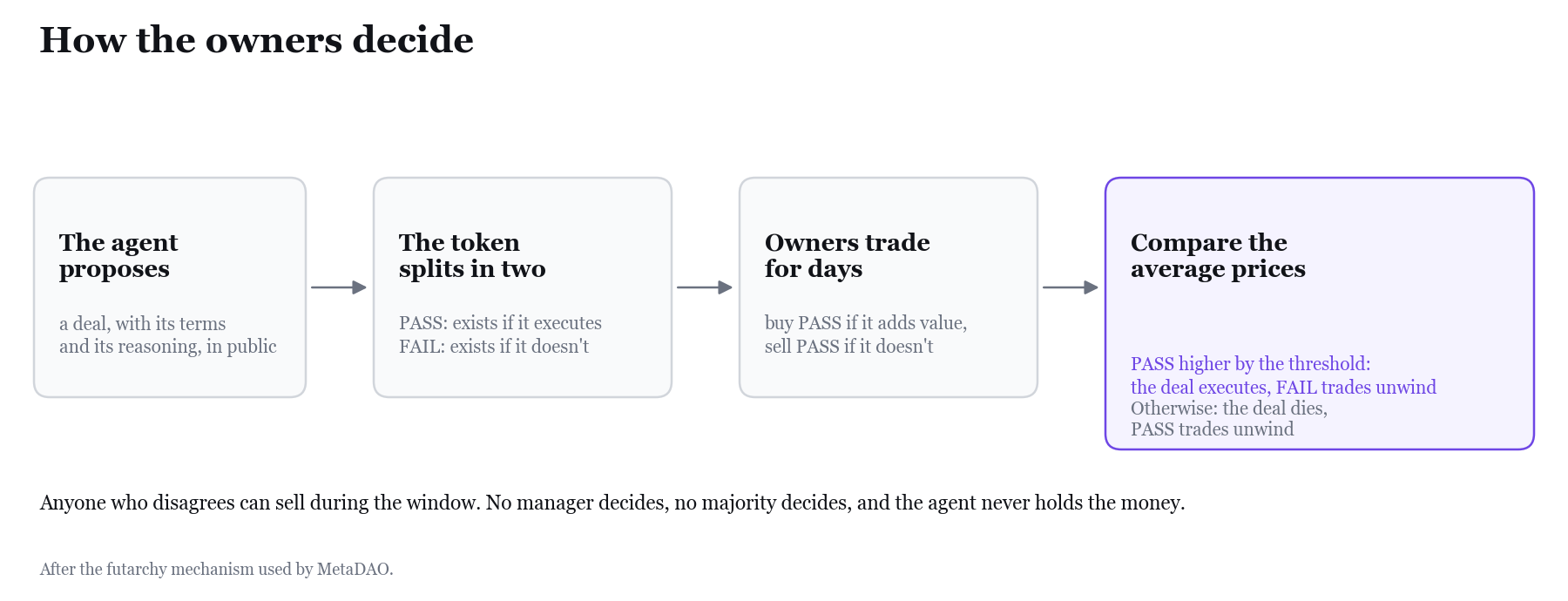
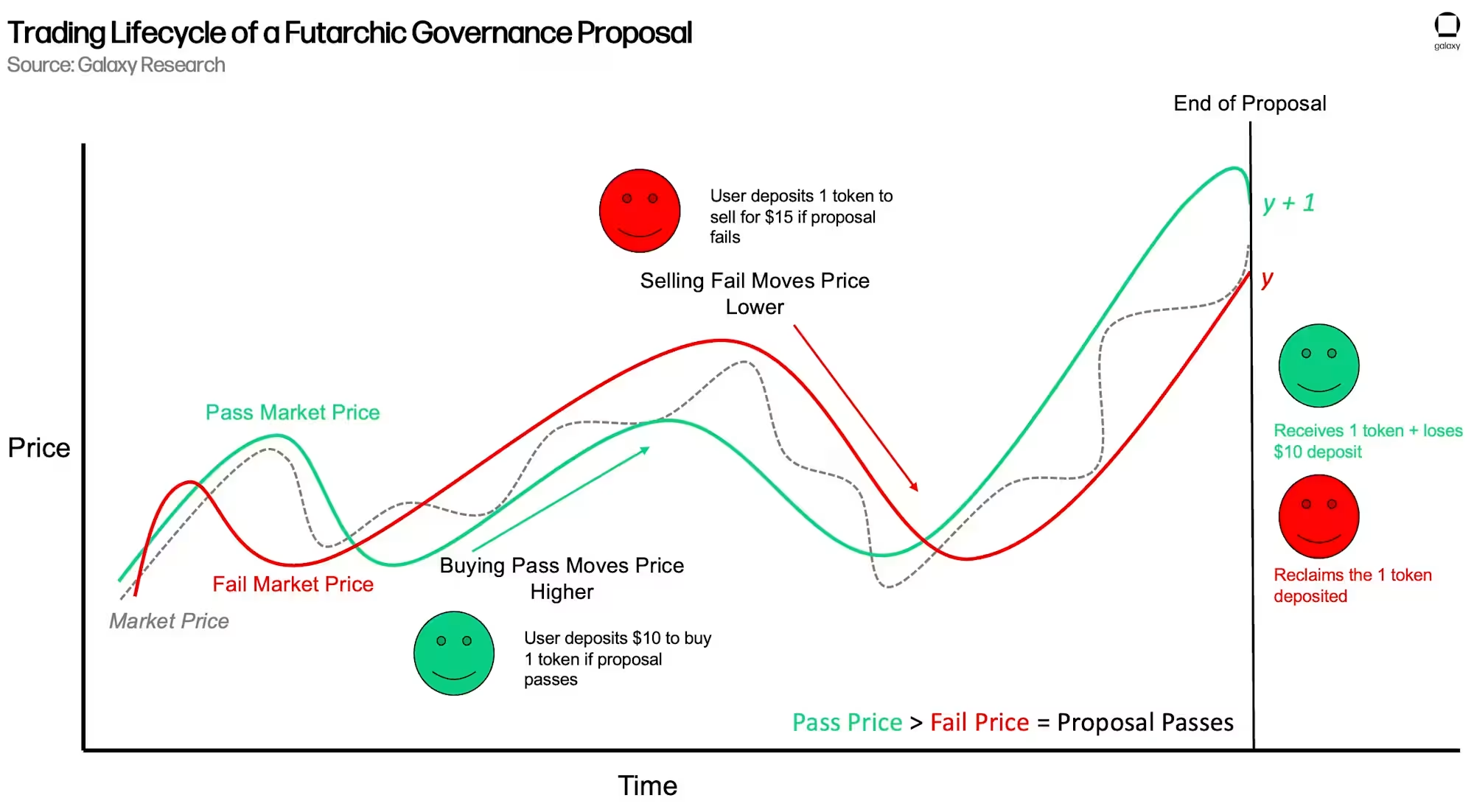
When a proposal is made, the fund's token splits into two conditional versions: one that exists if the proposal passes, one if it fails. For a set window, any owner can trade either. If you think the deal will make the fund worth more, you buy the pass version. If you think it will make the fund worth less, you sell the pass version or buy the fail version. At the end of the window the mechanism compares the two prices, averaged over the period. If the pass price is above the fail price by more than a set threshold, the proposal executes automatically and the pass trades settle: buyers get their tokens, sellers get their money. If not, it dies and the fail trades settle instead. Either way, every trade on the losing side is unwound as though it never happened. The window and the threshold are set by the owners, and within those bounds the agent proposes the terms of each market along with the terms of each deal. Every investment goes through this. A prediction market tells you what will happen. A decision market decides what should. Zack Pokorny has the right description of what that makes possible: not better versions of existing organizations but entirely new organizational forms, of which agentic capital is one.
Two things follow that no vote can provide.
First, nobody can profitably take the fund's money. Suppose a majority holder proposes sending the treasury to himself. For the proposal to pass, the pass version of the token has to trade above the fail version. But a pass version is worth nothing, because after the transfer the fund owns nothing, and a fail version is worth the whole fund. To win, he has to buy worthless tokens above their value from anyone willing to sell, and the smallest holder can sell to him all day. In MetaDAO's first months Ben Hawkins ran the milder version, a proposal that the DAO sell him tokens below market, backed by heavy buying to push the market his way. It failed, and in his own write-up the cost of moving the market outweighed what the discount would have been worth. The protection depends on no court, no majority and no one's good will. It depends on any holder being able to trade.
Second, and no limited partnership agreement has ever offered this: you can leave a decision you disagree with, on fair terms, at the moment you disagree. Sell your pass tokens during the window. If the deal goes ahead, you have been bought out by the people who wanted it, at a price they thought cheap and you thought rich. If it dies, your sale never happened and you own what you owned. The principal-agent problem does not get managed here. It gets dissolved, because the principals willing to put their skin in the game on a particular decision, in aggregate, decide. A stake is a belief you cannot fake, and the market is measuring it.
And this is what lets an agent hold money at all. The agent does not control the buys. Decision markets do. The agent proposes, the market decides, and a rule executes only what the market approved, through a signatory bound to it. A prompt injection can corrupt a recommendation; it cannot move the fund, because the fund moves only when its owners have priced the move. The market is also the surface for what the agent does not know: anyone who sees the missing fact, the stale assumption or the flaw in the thesis can trade on it, and the signal arrives with money behind it. The agent does not need to know everything. It needs a system that pays the people who know what it is missing. That is what governance by stake looks like, and it gets smarter and more robust as its volume, its participants and its assets grow.
Greater than the sum of its parts
Each of the three is useful alone. Together they make something with no precedent, and the cleanest way to see it is what each of the three lacks without the others.
A market without an agent protects owners and originates nothing. mtnCapital, the first fund governed by a decision market, raised $5.76 million from 1,931 people on MetaDAO in March 2025 with no manager and no thesis. Its owners' market rejected every investment proposed to it and approved every proposal that returned capital: buybacks below net asset value that enriched the holders who stayed, then a redemption in September 2025 that paid its owners about $0.60 a token, against the roughly $0.58 they had paid. The mechanism protected investors completely, and nothing was built, because a market can only choose between the proposals put in front of it. An agent without a market is a wallet waiting for February. An AI inside a normal fund, which is where the largest firms are heading, leaves the manager's margin and the manager's authority exactly where they were. And a market without a token is a crowdfunded pool of a hundred owners who cannot leave and whom nobody can join, too thin to protect anyone and too small to matter.
With all three, you get a fund whose owners can be anyone, whose thesis is worked every day by an agent and sharpened by everyone who knows something, and whose every consequential decision is made by its owners, each of whom keeps an exit. That is agentic capital.