 Agentic Capital · Money Goes Where It Is Trusted
The future is being built where you can't invest
Value is not a fact about the world. It is a social technology, something humans invented and keep improving, and it exists because groups that shared an idea of value could coordinate where others could not. Every improvement to it has unlocked a new scale of cooperation. A flexible idea of value let early humans trade beyond the tribe. Money let strangers exchange in markets and carry value through time. Credit let the future finance the present, and paid for the age of discovery. The joint-stock company let strangers own together, and paid for industry. Each was an innovation in finance before it was an innovation in anything else, and each decided what the next age could build. It is still true. This year's AI buildout runs on new financial instruments as much as on new chips: American operators have raised more than $80 billion since 2018 by securitizing data centres, against under $2 billion in the European Union. As Will Manidis put it, Europe is losing the buildout not because it cannot build the technology but because it cannot finance it.
Capital exerts gravity on the future. An industry forms where someone financed it, and the next technology grows out of the industries that came before, so what gets financed early shapes what is possible later, and whoever supplies the capital owns what forms. And because the returns from financing the future follow a power law, with a few companies producing most of the value of an entire era, the question of who gets to supply that capital, and who gets to own those few companies, is one of the largest questions there is.
Today the answer is an investment system for the super wealthy. Venture capital is the machine that finances innovation now, and it is better at the job than any public market. It is also open to almost nobody. To own what it finances you must be accredited, which in America means roughly one household in five, and you must know someone, which rules out most of those. And the companies it finances now grow up behind that wall. The five most valuable private companies in America were worth $25 billion on average in 2015. Today they are worth $473 billion. Amazon compounded in public. Its successors compound in private, where almost nobody can buy in.
Why does it matter that a few people steer? Three reasons. The upside goes to them: the largest fortunes of the next decade will be made by the companies that automate work, and the people whose work is automated will not own them, because they were never allowed to buy in. Leave that alone through a decade of AI and robotics and you get a permanent underclass. The judgment is theirs too: a few thousand partners from a few schools and a few cities decide which futures get financed, and they steer toward what they know, what their peers are backing, and what returns a fund of the size they have raised. When most of the value of an era comes from a handful of companies, the blind spots of the handful of people choosing them matter more, not less. And the technologies being financed are general-purpose. AI, robotics and biotechnology will reshape every industry and most lives. A future steered by a few is a worse future even when they are right, and a dangerous one when they are wrong.
It is also a waste, because knowledge is spread through the economy in a way that capital is not. A machinist with twenty years on the floor knows which jobs a robot can take tomorrow and which will defeat it for a decade, and can tell which of the companies building those robots understands the work. Every industry is full of people like her, and no venture fund will ever hear from them. The AI labs will, because she teaches their models how her work is done every time she corrects one, and she will own none of what they learn. That is agentic Taylorism, and this essay is our answer to it. In 1602 a maid could sign the register. Today someone who can see where her industry is going has no way to own that future and no way to help steer it.
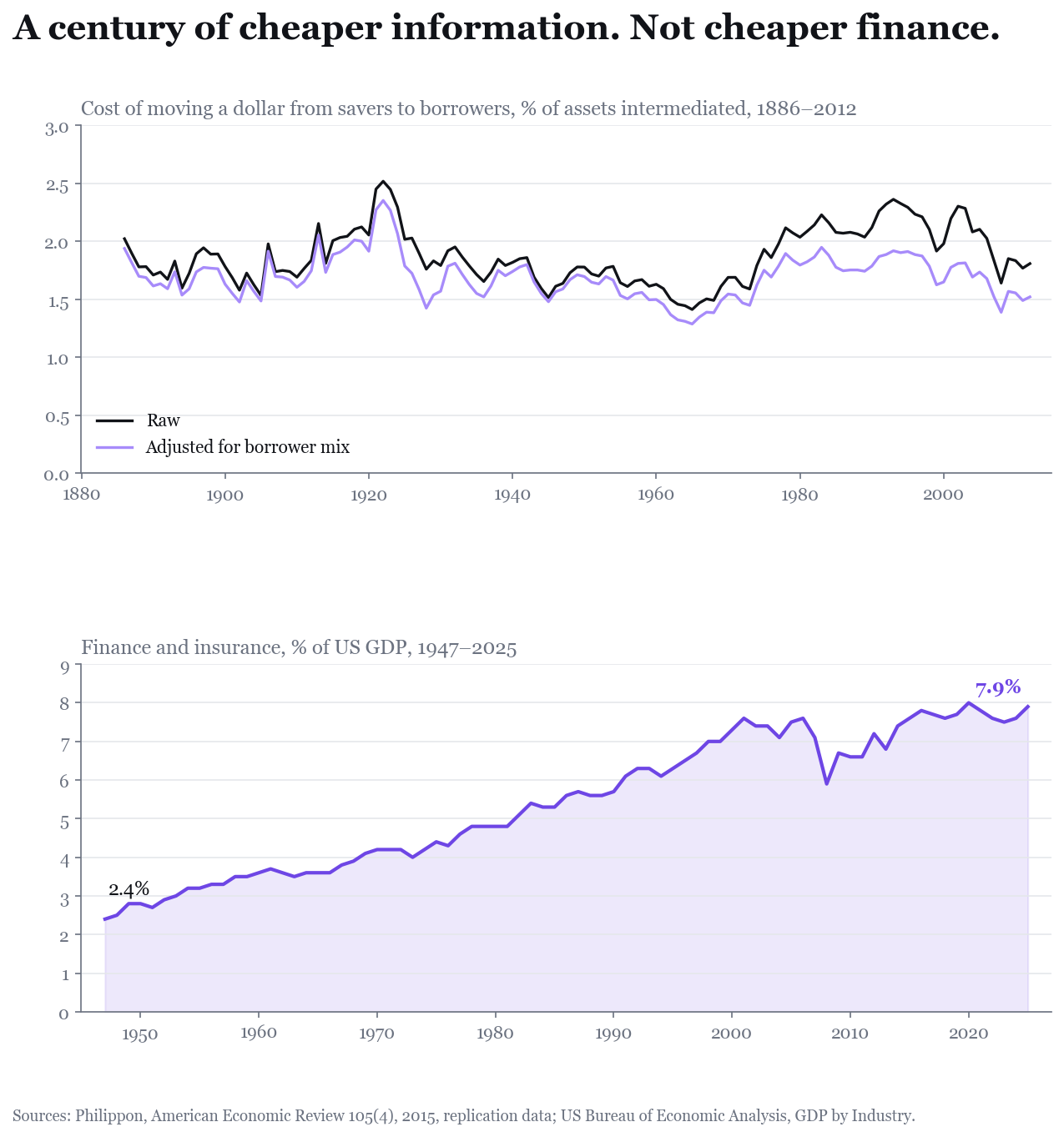
None of this reflects an industry that has been getting better at its job. The cost of moving a dollar from a saver to a business in America stayed between 1.5 and 2 percent of the assets intermediated from the 1880s to the 2010s, through the telephone, the computer and the internet, while finance and insurance grew from 2.4 percent of the economy in 1947 to 7.9 percent in 2025. Most industries built on information got cheaper as information got cheaper. Finance got bigger, and its managers got wealthier and more important.